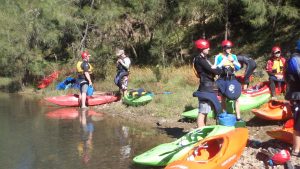
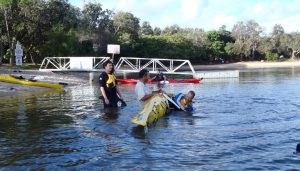
This is your chance to learn how to paddle the exciting sport of
whitewater kayaking.
Date: Sun 12th March 2006
Duration: 8.30 AM return around 5 PM
Destination: Wivenhoe Spillway
Paddle type: Whitewater kayaking
Numbers: Max 13 people – book soon!
Pictures: Pictures from a previous introductory day are available
Requirements:
No experience necessary– the club has all the gear you need
Cost: $10 donation for boat maintenance
Meet: At UQ Canoe club boat shed (building 30) at 8:30 AM sharp!
Contact: Paul Bates (via email) or 0413 586 551 (phone)
Trip Report
We had a very successful trip to Wivenhoe Dam with 17 people turning up for the trip (a few more than had booked, but it worked out just
fine). Pictures are available off-site
Basic Whitewater Skills at Goolang Ck – Sat/Sun 1st-2nd April
NOTE: If you are already a confident whitewater paddler (can roll in
moving water etc…) and don’t need instruction, and are willing to
use the boats we don’t need, then feel free to come along. It will be
great to have you guys there!!! (There are some great play waves!!!)
Goolang creek is the best place to develop your skills in a Kayak.
This weekend is for people of all skill levels to get out and play or
learn. Some of the senior club members will be teaching you the
important skills required to paddle whitewater safely. We will camp
right next to the river.
Date: Sat 1st and Sun 2nd April 2006
Duration: 2 days
Destination: Goolang creek
Paddle type: Whitewater kayaking
Numbers: Max 8 people – book soon!
Cost: $10/day donation for boat maintenance plus $8 for camping and
about $15 for petrol
Contact: Simon Vos – whitewater representative
Prior bookings are essential – maximum of 8 people
Nymboida River – Easter Weekend Fri-Mon 14-17 April
We will be kayaking/rafting down the Nymboida River from Platypus Flat
to the Junction. People who can’t make the whole duration of the trip
can arrive on Saturday evening and meet us at the Codhole.
Date: Fri 14th to Mon 17th April 2006 (Easter weekend)
Duration: 3-4 days
Destination: Nymboida River
Paddle type: Whitewater kayaking
Numbers: Max 6 persons on raft and about 6 kayaks. – book soon!
Cost: $10/day donation for boat maintenance about $20-$30 for petrol
and a little more if you want to get on the raft
Contact: Simon Vos – whitewater representative
Prior bookings are essential – maximum of 6 or 12 people
Introduction to White-water Day – Sun 20 Aug 2006
Anyone interested in white-water kayaking is encouraged to come on this training trip. Details will be posted soon. Check back here.
Time: Sun 20 Aug
Duration: 1 day
Paddle type: Whitewater kayaking
Requirements: Basic fitness. Prior bookings are essential
Gear: Swimming clothes, shoes you can get wet, sunscreen, hat, towel, water (2L), food (we will visit the local bakery on the way up)
Meet: UQCC Canoe Shed at 8AM, return about 4:30PM
Destination: Wivenhoe Dam
Contact: Simon Vos (whitewater kayaking rep)
Beginners Surf/White-water weekend 26 Aug 06
A semi-social trip to Byron Bay to train/play in the waves. This trip is sea-kayaking friendly, and confident sea kayakers are welcome. This is a chance for white-water and seakayak folks to meet up, compare skills, and share the odd beer.
Fri 25th: Drive down in the evening (or the next day if you can’t make it Friday) Sat 26th: Camp, Surf, Sea kayak, sit by fire and have a good time. Sun 27th: Camp, Surf, play and head home at a reasonable hour.
Time: 25/26-Aug 2006
Duration: 2 days/1-2 nights
Paddle type: Whitewater kayaking (competent sea kayakers welcome)
Requirements: Basic fitness. Prior bookings are essential
Gear: Camping gear, kayaks, food, hat, sun protection, towel, swimming gear, water bottles, safety gear (life-jackets, helmets, etc), 2L water
Meet: Friday 25th Aug (evening) at boat shed around 6PM. Drive to Byron.
Destination: Byron Bay
Contact: Simon Vos (whitewater kayaking rep)
Tully trip – 22-30 September 2006
Time: 22-30 September
Duration: 9 days
Paddle type: Whitewater kayaking
Requirements: Basic fitness. You must be able to roll competently to go on this trip. Places are limited, so book in advance.
Gear:
Meet:
Destination: Tully
Contact: Simon Vos (whitewater kayaking rep)
For changes & additions to the report, please contact the webadmin
The club regularly organises trips to destinations off campus. These can be one day, weekend, or multi-day trips located in Queensland or interstate. Destinations are typically rivers, lakes, estuaries, islands, and bays around south-east Queensland. Sometimes they even include artificial beaches (aka South Bank) for competitions or exhibitions.
To find out about planned official club trips, please consult the trip/event calendars for each kayak area.
There aren’t always enough places in official trips for all members to learn as much as they would like. Additional, unofficial trips are often organised amongst individual club members on a private basis, without the involvement of the club committee. Instead, enthusiastic members put together their own trip where they can spend more time learning from each other. Because private trips are among friends, they can more quickly respond and adapt to prevailing weather conditions and circumstances.
To find out about any private trips, come to the regular paddle sessions, meet people, network, and make friends with club members who have similar interests.
Please be aware that the club is not associated or involved in any trips organised by its members on a private basis. The club does not monitor, organise, or necessarily have particular knowledge of privately arranged excursions.
Organise your own Trips
If you are an experienced paddler, you might consider going on your own trip somewhere, preferably with other paddlers. Better still, you could organise an official club trip if you have sufficient competence (this requires committee approval). The club may also help subsidise any accredited training that you undertake which will help you to organise trips (prior approval of the committee is required for this too).
This page shows a list of weekend tide times and some potential trips that are favourable for the tides.
The list is a guide to aid club trip planning and scheduling and may include errors and misinformation. Not all trips have been attempted and information could be wrong or unfeasible. Conditions may also have changed since a trip was last attempted. Please check the official tide times, do your own additional research and scouting, and make your own trip plans carefully yourself.
To find out about unofficial private trips organised independently by members of the club, please attend some of the regular weekly paddling sessions. You need to make friends and network. Meet other experienced club members who share common interests, and perhaps organise your own private trips – commensurate with your abilities and experience.
Contacts
For enquiries regarding specific trips, please contact the person organising the trip.
Mike Brown, Jonathon Peake, Ben Barry and Carolyn Proellochs kayaked to Peel Island from Victoria Point to spend a night on Peel Island and paddle back the following day. A lovely smooth paddle with sea turtles and wrecks to look at. The camp site in Halfmoon Bay is a nicely sheltered spot.
MORETON ISLAND
On a lengthier crossing Jonathon Peake, Mike Brown and Ben Barry, from the club, left from Manly and headed straight for the Moreton Island Little Sand Dunes after a brief stop on Green Island. Dugongs were about on the trip over, and the middle day of the trip provided a nice opportunity to paddle along Moreton’s bay side shores with a dolphin. The trip back was via St Helena Island swinging close to Mud Island.
Sea Kayaking Trips for Andrew Kapa, John Pascua, and friends.
During the year Andrew and I participated in a sea kayaking proficiency course at Mooloolaba under the instruction of Gayle Mays. Since then, we have undertaken several sea kayaking trips.
Two separate trips were conducted over 2 and 3 days through Moreton Bay. The first I did with friends, going from Victoria Point through Karragarra Island and Maclay Islands to Blakeley’s Anchorage at Straddy and then to Peel Island where we camped over night. It was a big paddle the next day, as we made it to St Helena Island. We were lucky to have a SE wind behind us as we continued through to Nudgee Beach. My colleagues made use of this wind and used their sails. I had a hard time keeping up so I ended up scoring a tow – I know, I’m a cheat! But I wasn’t going to get left behind.
The next trip through Moreton Bay, Andrew and myself went with two other friends. Leaving from Cabbage tree point we paddled North and then through the passage between Karragarra Island and Russell Island (where we stopped for brunch) and then over to Blakeley’s Anchorage where we set up camp. It was a great paddle – very calm and reasonably warm. We were even fortunate enough to see dolphins, turtle’s, and a dugong.
The next day we paddle to Peel Island where we had lunch on the North side in the Mangroves. We then paddled over to Green Island to camp. On the way we privileged to see a humpback whale and it’s calf only 20 metres off our bow. It was awesome! When we got to Green Island we copped a low tide and we had to negotiate an oyster reef. I’m bringing my oyster knife next time.
The third day saw us paddle over to Whyte’s passage and up the Brisbane river to New Farm – stopping at Colmslie Beach for lunch. We paused at Whyte’s Island for half and hour to watch a pod of dolphins play and I guess ambush fish. They came right up to the kayaks though – a fantastic experience.
Andrew and I then tackled the Pumicestone Passage. We had no idea what it was going to be like so we put in at Coochin Creek and paddled through to Caloundra. It ended up being too short. We were finished in a couple of hours. We did get an idea of how strong the currents were in the passage though. Tides should be taken into account.
So our most recent trip ended up being the whole passage – from South Bribie Island to Caloundra. We timed it with the tides and camped over night at Mission Point (across from Donnybrook). You can’t miss Mission Point, it’s well signed and very obvious on the Bribie Island side. If you ever camp there, take heaps of mozzie repellent though. They were really bad. We nicknamed it Ningi Point (“Ningi” is aboriginal for “mozzie”).
I took my fishing rod and yabby pump on the trip. There were heaps of yabbies on the bar in front of the point but fishing in front of the campsite was full of snags. I have found a good nearby fishing spot since but you’ll have to come out paddling with me to find out where. The tides, by the way, were extremely helpful in making it a pleasant trip.
A Lovely paddle through Nundah creek and the Boondall wetlands. There is lots of birdlife and very interesting paddling. This trip will be a full Day. There are limited numbers on this trip (limited by transport for people and kayaks).
We will depart from Shorncliffe on Cabbage Tree Creek beach. Drive along Allpass Pde to a good spot.
Morning circuit (9am to 11am):- We will proceed up Cabbage Tree Creek and back for a two hour leisurely paddle with frequent rests, aiming to be back at the beach by 11 am.
Stroke and rescue practice (11 am to 12 pm) This will be an opportunity for everyone to practice stroke and rescue techniques with more experienced kayakers providing assistance.
Lunch (12 to 1pm): We will kayak back to the Fish Cooperate for a fish lunch.
Anyone who has had enough can return to the beach and enjoy the pleasures of Shorncliffe during the afternoon (bring a book!)
Afternoon Circuit (1pm to 4pm): A final decision about the afternoon circuit will depend on the weather and the skills of the participants as assessed by the leader. It will also depend on having sufficient kayakers with experience to help and teach beginners. We will not go on to Moreton Bay unless conditions are favorable and the group has the required basic skills both to kayak and to rescue.
Option A
Weather and skills permitting we will exit Cabbage Tree Creek before the tide turns (high tide 1.33pm) then proceed across the sand banks (shallow water) south along the coast between Mangrove trees towards the Brisbane river. We will return to Cabbage Tree Creek via Nudgee Creek and Nundah Creek with a short portage between them.
Option B;br>
If there are concerns about the weather or other matters then we will explore the Nundah Creek returning to Cabbage Tree Creek with the outgoing tide
Safety:- Sea kayaking on Moreton Bay can be hazardous, particularly in river mouths with an outgoing tide. Because this is an introduction for sea kayak beginners we will exit the creek before the tide goes out and will paddle across shallow water over the sand banks along the edge of the bay
Grade: 1
Time: Sun 11 March 2007
Duration: All Day. We will plan to be off the water by 4pm and back at the shed by 5pm. Up to 4 hours kayaking and up to 1 hour practicing.
Distance: 15km. We will be looking at a total distance of around 15 km or more if everyone is coping well. This is a pleasure outing.
Paddle type: Sea kayaking Requirements:
Basic fitness – although this trip will cater for beginners, some basic skills and some fitness by kayaking on the river are required. If you can kayak comfortably up river from the club to the green boy on the rocks and back then you should manage the morning circuit. You can then decide on the afternoon circuit.
Basic skills training session. You must have already attended a Nasic skills training session at the St Lucia Shed. It is UQ club sea kayaking policy that only those able to demonstrate that they can use a skirt, do a wet exit and an assisted rescue will be taken onto Morton Bay. The practice session will enable you to learn and demonstrate these skills.
Prior bookings are essential
Required equipment: Sea kayaks, skirts, paddle leashes, bailers and PFDs are required. Bring snacks, at least 2L WATER, sunscreen, hat, sunglasses, insect repellant, money, hat, towel, swimming gear and change of kayak clothing as you will get wet.
Basic Costs: Money for Lunch (or bring your own) about $10. Money to put toward petrol of your driver (about $5-10). Money to donate for kayak upkeep (about $5)
Meet: 7:15AM at the UQ Canoe Club to load kayaks. Depart 8am and drive to Shorncliffe (near Jetty at junction Allpass Pde and Sunday Rd – Brisbane UBD Map page 9)). Aim to be on the water by 9am or soon after.
Tides: High tide is at 1.30 pm so we will be kayaking both with and against the tide.
Registration: Please register your interest with the leader by email (first come first served). Please indicate whether you have transport and if you have roof bars for kayaks. If you have not kayaked with the leader before please give some indication of your skills level to assist planning. We do not intend to turn people away because they are beginners.
Organiser: Michael Wynne
Leader: Dave Loveridge
Contact: Michael or Dave Loveridge (sea kayaking rep)
Report
This was the first trip of the year, and had a roughly equal mix of older club members and new members on their first sea kayak trip. We arrived at the Shorncliffe boat ramp, where the Sandgate canoe club has its kayak washing station, and departed on schedule. We set off up Cabbage tree creek for a couple of hours exploring the Mangroves. All the club’s sea kayaks were in use, and the double kayaks forged ahead with the new one (on its maiden trip) leading the way. It was also the first trip for Marj’s flash new fibreglass sea kayak – very nice. Despite the progress of the doubles, it was a leisurely meander upstream in ever increasing heat. Luckily a decent onshore breeze saved us from too much discomfort in what was otherwise a very hot day. We returned on schedule, but postponed the training sessions because the water was uninviting, particularly with respect to the number of jellyfish. We settled down to a lazy lunch instead.
After losing a couple of paddlers to the lures of an afternoon kip, we headed off along the shore and into the bay. On our way out of the creek we hit a patch of very high density jellyfish, with probably around 20-30 per square metre. In the bay the breeze was driving some onshore waves which provided a useful first experience for the new paddlers. However, the waves were just too small to demonstrate the utility of spray decks, or to provide a decent taste of surfing fun. We played in the bay waves for over half and hour before coming through the mouth of Nudgee creek at high tide.
After a short trip up the creek, and a demonstration of some novel paddling techniques, we ported the kayaks across to Nundah creek. The opportunity was taken for more stroke and paddle training before heading back to Shorncliffe and the trip home.
– M.W.
Pumicestone Passage
We will start from Golden Beach Caloundra and kayak 16 km to a campsite half way up Coochin Creek where we will spend the night. We will make an early start on Sunday to kayak about 26 km from the Coochin Creek camp site to the Bribie island bridge.
Details
Tides in the Bribie passage can be very strong at both ends so it is important that we use this to our advantage fully. The time we take and opportunities for exploration will depend on how well we do this.
On the way up to Caloundra we will leave cars at the Bribie bridge and at the Coochin camp site (with heavy camping gear, food etc.).
We will try to get on the water before 10 AM. This should give us an hour or more to kayak across to a narrow area of Bribie Island where we can swim or walk across to the sea and beach while we wait for the tide to slow. It is possible to carry a kayak or two across and play in the surf. We will start up the passage and leave Golden Beach at 11 AM, This is one hour before low tide. It should take 3-4 hours of kayaking to reach the camp site in the late afternoon, depending on the wind.
On Sunday morning we will pack up early, and be on the water by 7 AM. An early start means we can explore Tripcony Bight and other areas, and still reach Bribie bridge soon after the tide changes at 2.15 PM. This last part could be hard work against a strong tide at the end of a long trip, so we will try to avoid this by starting early. This is a long trip, and is a good 5 hours of actual paddling, not including stops to rest. It may be against the wind.
The Bribie passage is scenic, and is lined along much of its length with mangrove and mud bank with the glasshouse mountains in the distance. There are exit points, but they are infrequent in some areas. In the centre is the fish breeding reserve called Tripcony Bight. It is only navigable at high tide which is when we will explore it. Bird life is abundant as are insects, so bring repellent.
Safety note
The prevailing wind is usually from the south east, so we will probably be paddling against the wind. Although these are sheltered waters, parts of the passage are up to 3 km wide and can be rough, so skirts are required. Some central parts are only a few metres wide.
Contingency plans
There are access points at the towns of Donnybrook and Toorbul on the Sunday so we can drop off anyone finding it too difficult on day 2, and retrieve them at the end of the day. If strong or gale force SE winds are predicted (as they were last time) then a last minute change to plans may be made – leaving much earlier on Saturday, starting at the Bribie bridge, and ending at Caloundra on Sunday.
Time: Sat-Sun 14-15 April
Duration: 2 Day / overnight
Paddle type: Sea kayaking
Distance: Approximately 16 km (day 1) and 26 km (day 2)
Tides: Low tide (Caloundra) at midday on Saturday, and at 2.15 pm at Bribie bridge on Sunday. High tide in the centre of the passage will be approximately 8-9 PM on Saturday and at 9-10 AM on Sunday. This is 2-3 hours later than the time at Bribie and Caloundra. Requirements:
Basic fitness – You must be able to paddle for 2 hours at steady 5km per hour, and a total distance of 26 km
You must have already attended a training session at the St Lucia Shed and learned basic paddling and rescue skills.
Prior bookings are essential
Accommodation: Camping. The club has basic camping gear (tents, sleeping bags, sleeping mats, cooking stoves) – if necessary check and book it well beforehand. Please let us know what you need.
Gear: Kayak gear (the club has this) including skirts, pdf’s, dry bags, paddle leashes. Personal gear – sunscreen, insect repellent, hat, sunglasses, warm clothes, food, snacks and over 6 litres of water. It is not known if there is fresh water at the camp site.
Basic Costs: Camping fee (to be determined), a contribution to petrol to be determined afterwards, and a voluntary boat/gear donation to the club (towards up-keep) for those who can afford it.
Meet: Canoe club shed at 7 AM on Saturday 14 April 2007. Load boats and depart before 8 AM
Destination: Pumicestone Passage – Caloundra, Coochin Creek, Bribie Island
Return: Sunday 15th April late afternoon. Or early evening.
Coordinator: Please register interest with Michael Wynne before 7th April. Please supply email and phone (mobile) contact numbers if I donít have them.
Moreton Island 2007
We will be catching the Barge from Lytton to Tangalooma and camp somewhere around Tangalooma. We shall paddle along the island during the day, following the tides. On the Sunday we will paddle to the sand hills or snorkel around the wrecks at Tangalooma. Monday we will return to Bulwer for the Barge back to
Lytton. There are additional costs such as the barge and camping
fees.
Time: Sat 5th May – Monday 7th May (Labour day long weekend)
Duration: 3 days / 2 nights
Paddle type: Sea kayaking Requirements:
Accommodation: Camping. The club has basic gear – if necessary check and book it well beforehand.
Gear: sunscreen, hat, warm clothes, organise transport and food
Basic Costs: $80 – these include the barge and camping
fees
Meet: Fri 4th May 6:30 PM (packing), and Sat 5th May 3:15 AM (leaving) at the club shed
Destination: Moreton Island
Contact: Dave Loveridge (sea kayaking rep)
Report: After a very early departure, we made good time to the barge. The organisation and planning paid off, and we loaded our things quickly and easily. The sunrise while we were on the ferry in the middle of Moreton bay made the early start worth it. The trip time was used to repack the kayaks so we were ready to immediately set off for a very early paddle through the Tangalooma wrecks when we landed – again well worth it. We paddled over to Tangalooma point where we set up camp (we had first choice of sites on a very busy weekend!), and had something to eat. Afterwards, we paddled south past shark point for a quick swim, and then back back to Tangalooma where we met Marj and Paul. They had kayaked across from Bribie island, and joined us for the weekend. We had some lunch, a swim amongst the wrecks, and an afternoon snooze to fix the early start. The water was pleasant, and there were many fish and corals growing on the wrecks. When the tide was right, we returned to our campsite for the evening.
The next day we took a trip further south, spotting rays, turtles, and even a small shovel-nosed shark along the way. We stopped at the Big Sandhills for lunch. The sandhills were impressive, as was the view from the top. We weren’t far from the southern end of the island. After lunch and a swim we paddled back to the campsite. The water was so beautiful and blue-green on the way back that we couldn’t resist a jumping overboard for a swim. After same afternoon nibbles, we walked down to the resort for a beer, and did the tourist thing – watching the dolphin feeding just after it got dark.
We had an early start the next morning, especially those who got up with Marj and Paul who’d decided to leave us early and paddle back to Lytton (via Mud island). We packed up the camp and had an easier than expected paddle against the current over to Tangalooma to meet the ferry. Consequently we took a small detour via the point at Cowan Cowan, and a last swim to the wrecks. We were lucky to catch the early ferry back because the winds picked up, and it wasn’t as nice a day as the previous two. Despite the conditions, Marj and Paul beat us back to Lytton. – M.W.
Coochiemudlo & Macleay islands (changed from Peel island due to weather)
Trip completed
[Original trip plan (Peel island) – Cleveland to Peel Island for lunch, a play and a swim and then back. It would be approx 20 km of paddling in the day, including a 5-6 km crossing from the mainland. If this sounds like something your interested in let me know. It will depend a bit on the weather.]
This trip was altered due to weather conditions.
Poor weather conditions: The trip will instead go to Victoria Point where it is more sheltered, and kayak around the islands there (Coochimudlo and Macleay islands) subject to weather conditions
UPDATE The forecast is for poor weather, so Victoria Point and adjacent islands are the planned destination unless there is a change. BE PREPARED for wet, cold, and windy weather.
Time: Sat 26 May
Duration: 1 Day
Paddle type: Sea kayaking Requirements:
Gear: sunscreen, hat, warm clothes, organise transport and food
Basic Costs: donation to the club for equipment use & petrol money
Destination: Coochiemudlo and Macleay islands, Moreton Bay
Contact: Dave Loveridge (sea kayaking rep)
The trip was completed. We traveled from Victoria point, along Coochiemudlo island, and then headed across to Macleay. After navigating the low tide sand banks between the two islands, we followed the north end of macleay island to and rounded the eastern end. We then surfed the small swell back to Coochiemuldo for lunch. Afterwards we continued around Coochie, noting the corals in the water, and arrived back at Victoria point in good time.
Rous River, Tweed Valley NSW
Get into the semester with paddle from Tumbulgum (on the Tweed River), travelling up the Rous River (pronounced “Russ”) with the tide to the limit of the tidal range (just past the boat harbour bridge (~20 km). There are exit points after 10 km and 15 km if needed. We will be taking sea kayaks, and slower paddlers will use Rosco kayaks.
Distance: 19.5 km (exits at 10km and 13 km if needed)
Date: Sat 21 July – the weekend between O-week and the start of semester
Duration: 1 Day
Grade: 1 – note 19.5 km is 5 km longer than a normal grade 1 trip. However, it is with the tide.
Paddle type: Sea kayaking / Flatwater Requirements:
Gear: sunscreen, hat, warm clothes, organise transport and food
Basic Costs: Kayak usage donation / petrol money
Meet: Club shed – 6:30 AM
Return to shed ~5 PM
Destination: Rous River, NSW
Contact: Michael Wynne
Trip completed.
Coomera island (Gold Coast)- Sun 2 Sept 2007
Circumnavigation of Coomera island, leaving from Paradise point, and returning via Wasp Creek. The trip will go up the south arm of the Coomera river, then down the north arm, and through Wasp Creek and back to Paradise Point along the Broadwater. The trip will be partly river and partly on the more open Broadwater which may be choppy, giving some experience in slightly rougher water for beginners.
Info: Coomera island satellite photo/street maps
Time: Sun 2 Sept 2007
Duration: 1 day
Distance: 17 km (2-4 hrs paddling)
Paddle type: Sea kayaking
Gear: 2L water, snacks, sunscreen, hat, warm clothes, picnic lunch. Kayak gear includes PFDs spray decks, and paddle leashes.
Basic Costs: Petrol money to whoever you get a lift with. A donation to the club go toward gear replacement (if you are economically able – don’t let this stop you coming).
Meet: 7:30 AM at the club shed Sat morning (depart 8:15 AM)
Return: Return to Paradise point before 3 PM. Back to the club before 5 PM.
Put in: the beach off the Esplanade at Paradise Point, opposite the end of Muscovey Av – just south of the bridge to Sovereign Islands. QBD Map 8. R-13
Please let the trip organiser know if you can bring a car or if you can take a kayak (although this may not be needed) Requirements:
Basic fitness
Basic skills training session. You must have already attended a previous basic skills session on the river at the St Lucia Shed and be confident in doing a wet exit and assisted recovery. If there is no session rostered before this trip, please contact the trip organiser ASAP so something can be organised if possible.
You should have practised on the river, and developed sufficient skill and fitness to do the distance with a number of rests. If you can paddle from the club to the radio mast and back, in a sea kayak, in under 90 min you should manage.
Emergency rescue contact: Southport VMR (07) 5532 3417 (put this on your phone)
Pub lunch at Brunswick heads (Mullumbimby to Brunswick and back) – Sat 8th Sept 2007
We will Paddle from Mullumbimby down to the Hotel Brunswick at Brunswick Heads (approx 2 hours). We will have lunch at the Hotel. Afterwards we will paddle back to Mullumbimby (~2 more hrs). The paddle will go with the tide in both directions. The hotel beer garden overlooks the river/park where we will leave the kayaks. Paddles and other gear will be temporarily stored in an storage area of the hotel (by prior arrangement).
Meal costs: This hotel is a popular spot for an aussie counter meal (pub lunch). The meals at the hotel are a good size, and are not overly expensive. There are a couple of basic things (eg potato chips or wedges) for ~$5-8. Light meals are $8-$15. Burgers are $11-$12. The main meals are between $12 and $21 (typical ~$16). The most pricey is the steak at $22.50. If you are interested in the trip, but don’t want to do the pub meal, please let the trip organiser know. It is also possible to buy lunch elsewhere, or to bring your own.
Info: Google map of the river section
Date: Sat 8 Sept 2007
Distance: 22 km (11 km + 11 km) with the tide (lunch midway)
Duration: 1 day (~4 hours of paddling (2 x 2 hrs))
Paddle type: Sea kayaking
Gear: sunscreen, hat, warm clothes, lunch
Basic Costs: Petrol money to whoever you get a lift with. Lunch Money (~$10-20). Beer money if you wish (~$5) . A donation to the club go toward gear replacement (if you are economically able – don’t let this stop you coming).
Meet: 6: 45 AM – at the club shed on Saturday morning
Put in: The park (boat ramp) at the south end of Federation Bridge, Mullumbimby (where Tincogan St changes into Murwillumbah Road (Google maps calls this Coolamon Scenic drive). The park is adjacent, on Brunswick Terrace). Please take the turnoff to Mullumbimby south of the Brunswick river (from the newly upgraded section of the Pacific highway). Don’t take the Billinudgel turnoff and work south that way because the road is slow and winding, and there are roadworks and detours.
Please let the trip organiser know if you can bring a car or if you can take a kayak (although this may not be needed) Requirements:
Basic fitness
Basic skills training session. You must have already attended a previous basic skills session on the river at the St Lucia Shed. If there is no session rostered before this trip, please contact the trip organiser ASAP so something can be organised if possible.
Upper Noosa River Kayak trip, Sat-Sun 22-23 Sept 2007
This is an overnight trip taking sea kayaks and staying at Camp 3 in the QPWS camp grounds in the Cooloola National Park. We will leave from Elanda Point on Saturday and return on Sunday afternoon.
This is a very beautiful paddle on an unspoilt river. Have a look at pictures from a previous trip to the Noosa River a few years ago, as well as the report from last year
Info: Cooloolah National Park map where we will paddle, General information for kayaking in the area
Extra info: Local map of the area, Satellite map, QPWS Cooloolah National Park (Broad park map)
Time: Saturday 22nd and to Sunday 23rd of September 2007
Duration: 2 days (overnight)
Distance: 40 km total (20 each day, about 2-4 hrs paddling)
Paddle type: Sea kayaking
Accommodation: Camping
Basic Costs: Petrol money to whoever you get a lift with. A donation to the club go toward gear replacement (if you are economically able – don’t let this stop you coming). QPWS camping fees.
Gear: you will need camping gear and food for 2 days as well as paddling Gear. Please contact Dave for complete gear list – includes sunscreen, hat, warm clothes
Transport: Please contact Dave for transport info. Please let him know if you can bring a car or if you can take a kayak (although this may not be needed)
Meet: At the club shed Sat morning (time TBA)
Put in and take out: Elanda Point QPWS station. Requirements:
Basic fitness
Basic skills training session. You must have already attended a previous basic skills session on the river at the St Lucia Shed. If there is no session rostered before this trip, please contact the trip organiser ASAP so something can be organised if possible.
You should have practised on the river, and developed sufficient skill and fitness to do the distance with a number of rests. If you can paddle from the club to the radio mast and back, in a sea kayak, in under 90 min you should manage.
Byron Bay Christmas trip – Sat/Sun 24-25 November 07
The club is planning a big end of year Christmas weekend at Broken head (just south of Byron Bay). A mixture of sea kayaking and white water kayaking.
It’s intended to be a very social weekend, suitable for all levels, with skills training including rolling, wet exits, rescue techniqes, surfing, bracing, paddle strokes, white water and seakayaking as well as whale watching, napping, book reading, walking, photo opportunities, show and tell (about your favourite kayaking equipment/trip/experience) and general story telling. Add a few discussions of ideas for the coming year and directions for developing the club. The campsite is well equipped, pleasant, and surrounded by national park. A trip to Byron bay is very likely to expore its beaches – and for those who forgot to lodge a postal vote!
Info: Broken Head Nature Reserve, Broken Head Holiday Park
Grades 1-2.5
Time: Sat-Sun 24-25 Nov 07
Duration: 2 days
Paddle type: Sea kayaking and whitewater kayaking
Gear: 2L water per day, snacks, sunscreen, hat, clothes, food.
Kayak gear includes PFDs spray decks, paddles, and paddle leashes.
Basic Costs: Petrol money to whoever you get a lift with. A donation to the club to go toward gear replacement (if you are economically able – don’t let this stop you coming). Camping fees.
Meet: Time TBA at the club shed Sat morning (early)
Return: Sunday evening
Accommodation: Camping at Broken Head Holiday Park. The club has some camping gear you can borrow – contact the organisers
Please let the trip organiser know if you can bring a car or if you can take a kayak (although this may not be needed)
Requirements:
Basic fitness
Basic skills training session. You must have already attended a previous basic skills session on the river at the St Lucia Shed and be confident in doing a wet exit and assisted recovery. If there is no session rostered before this trip, please contact the trip organiser ASAP so something can be organised if possible.
Report
Most of us arrived gradually on the Friday. A few late comers managed to avoid most of the rain in the evening, find the campsite, and put up their tents. On Saturday we spent the morning playing in the surf on Clarke’s Beach at Byron Bay in both sea and whitewater kayaks. After returning to Broken Head for a lazy lunch, we either surfed, walked, lazed around, or played in the waves there. A shark was sighted next to a group of surfers at the end of the beach, which caused a small stir. The newspapers that weekend showed reports and aerial pictures of a number of large sharks swimming amongst groups of swimmers along the beaches at Byron Bay 12 km to the north. This all showed that the sharks had no interest in people.
Sunday morning got off to a relaxed start with a long swim and walk around the beach after packing up the camp. Lunch was in the park behind the beach, followed by some kayaking in the afternoon. A couple of members headed out some distance beyond the island off Broken head in sea kayaks, while others played in the surf in whitewater boats. – M.W.
Report
Six participants (Eric, Dani, Dave, Suzanne, Martin, and Michael) left Victoria point VMR jetty at about 9:30 AM for what turned out to be an easy ~15 km paddle around Coochiemudlo island.
A beautiful mangrove lined bay was discovered to the north-west of Coochie. A small shark, plenty of jumping fish, a ray, and sea eagles were encountered before morning tea on the far corner of the island (half way around). From there the paddlers set out for Maclay island, against a small breeze, where they found a nice beach for lunch – and were prompty joined by hordes of uninvited mosquitoes. A variety of corals were noticed in shallow water off Maclay on the way back to Coochie.
The afternoon was spent back at Coochie, next to the jetty, learning how to roll the kayaks, cooling down in the water, and eating ice-cream. The trip concluded at 3:45 PM after a paddle back to the VMR at Victoria point.
The forecast rain and storms failed to appear, and instead the sun was out for the day. Weather forecasters did not issue apologies, and yes they were still paid.
For changes & additions to the report, please contact the webadmin
North Stradbroke Island Weekend Adventure – 1 & 2 Apr 2006
Ideal for beginners and those wishing to try out the surf!
Camp at Cylinder Beach Camp Ground on North Stradbroke Island.
Day 1: (weather permitting) Paddle from Cylinder Beach camp site to Amity Point and back. Basic level 1 paddle led by Jitka Kochanek.
Day 2: (weather permitting) Play in the surf, learn new tricks at Cylinder Beach/Point Lookout. Level 3 Surf skills day led by Eric Peterson.
Grade day one: 1
Grade day two: 3
Time: Fri (night) 31 March / Sat (1 Apr) – Sun (2 Apr) 2006
Duration: 2 days (8 am to 5 pm each day)
Paddle type: Sea kayaking
Paddle distance: 20 km (10 km each way)
Destination: North Stradbroke island
Meet: Friday night 6 PM at the club shed for 7:45 ferry to Straddie- OR – Cylinder Beach Camp Site on North Stradbroke island either Friday night or at 8 AM either or both days
Transport: Book own ferry and organise own transport, including transport of your camping/sea kayak/food etc, to camp site
Accommodation: Car/camping at Cylinder Beach
Contact: Jitka Kochanek (social officer)
Moreton island – Sat 29 April 2006
The trip is tailored to paddlers who have children & babies not old enough to
paddle. We will take turns walking along shore with “Bubs in Macpacs” while
mums paddle, and then dads can have their go after morning and afternoon
breaks. We welcome other paddling families.
This is a joint event of University of Queensland Canoe Club, Griffith
University Bushwalking Society, and Queensland Sea Kayak Club.
Time: Sat 29 Apr 2006 to Mon 1 May
Duration: 2 nights
Paddle type: Sea kayaking
Accommodation: Camping near Cape Moreton
Gear: Sea kayaks, bushwalking, and camping
Meet: 8 AM ferry at Scarborough (North Redcliffe)
Contact: Eric Peterson
Beginners Surf/White-water weekend 26 Aug 06
Simon is organising a semi-social trip to Byron Bay for white-water folks to train/play in the waves. This trip is sea-kayaking friendly, and confident sea kayakers are welcome to come along. This is a chance for white-water and seakayak folks to meet up, compare skills, and share the odd beer.
Fri 25th: Drive down in the evening (or the next day if you can’t make it Friday) Sat 26th: Camp, Surf, Sea kayak, sit by fire and have a good time. Sun 27th: Camp, Surf, play and head home at a reasonable hour.
Trip Report The first day was spent playing in the surf, including an early morning outing to an off-shore break. A few whitewater folk had sea kayaks performing more tricks than they are used to – and yes sea kayaks are a lot harder to roll. A pod of over 12 dolphins were encountered. The broken head campsite was great.
The second day was spent on Watago bay, just below the lighthouse. We arrived with two whales passing by just offshore. More whales were seen during the day. The local surfers were invaded by our many whitewater kayaks, and a few sea kayaks and playboats, and again the waves and surrounding shores were explored. In the late afternoon the sea kayakers stayed on, and went for a a quick trip out to Julian rocks and back (~ 1 hr), through a rolling swell. During this excursion a whale crossed their path, submerging just in front of them. Whale breaches were seen in the distance on the way back. It was a fun trip where the sea kayakers had an opportunity to meet up with the whitewater people, see what they could do, and have a fun relaxing time.
Noosa – Sat/Sun 9-10 Sept 2006
Leaving Lake Cootharaba, we will paddle the river past Harry’s Hut to
Campsite 3 where we will spend the night. That afternoon people can
explore futher up the river and walk up to the sand patch. Before
returning to Cootharaba the next afternoon.
While not really sea Kayaing as such, it is a very beautiful paddle on
an unspoilt river. Take a look at pictures from a previous trip to the Noosa River, a few years ago.
Info: Local map of the area, Satellite map, Cooloolah National Park (pdf map)
Time: Sat/Sun 9-10 Sept 2006
Duration: 2 days / overnight
Paddle type: Sea kayaking
Accommodation: Camping
Gear: sunscreen, hat, warm clothes, organise own transport and food
Basic Costs: $15 per person
Meet: Noosa – Elanda point Canoe put in
Contact: Dave Loveridge (sea kayaking rep)
It was an early start as we left Brisbane on our way up to Lake Cootharaba. We
quickly packed the boats and, with a southerly behind us, we were blown across the lake and to the upper reaches of the river. After some quick snack stops at the Kinaba information centre and Harrys hut, we made it to campsite 3 just after lunch. We set up camp quickly, had some lunch, and then headed off on a walk to the Cooloola Sand patch.
The Sand Patch is a massive sandblow on top of the dunes that separates
the Noosa river from the sea. It gives some spectacular views of the
surrounding countryside. After some sight seeing and some great photos
we walked back to camp. The walk back was lovely and we were treated to
a beautiful sunset.
We woke early the next morning and found the river to be bathed in fog, it was an amazing sight. After some more photos we all went for a paddle
before breakfast. We paddled through the stillness and the fog, it was a
fantastic experience.
We quickly packed up camp and headed down the river, with the weather
slowly worsening as we went. At the lake we were greated by some big
chop, a nasty headwind, rain, and eventually a thunderstorm. After
putting the wet weather gear on, we paddled out into the storm. After
being tense at the start, we found it wasn’t as bad as we thought, and we
relaxed and enjoyed the paddle.
– D.L.
The campsite was basic, but sheltered, clean, and comfortable, with convenient solid tables and benches (also toilets). We had the site all to ourselves (it is booked per group), except for an overly friendly large goanna.
The view from the Cooloola sand patch was well worth the 12 km round trip. It gave us an eastern view to the sea which kept the sea kayakers happy, but it also afforded a fantastic western view of the national park all laid out before us. We could see lake Cootharaba and pick out our paddling route along the upper Noosa river as it snaked north past campsite 3 and beyond. The way the river travels between lakes Cooloola and Como added to the beauty and feel, as did the impressive windblown dunes we walked across. Dinner was a relaxed and enjoyable one, complete with a visit from a tiny, cute, plump, and very bold marsupial mouse.
The night was a little bit cold (not too bad), which gave us the wonderfully misty early morning to paddle through. This was a huge contrast to the later rain and stiff wind encountered on the last leg of the return trip, although this was a welcome kayaking challenge to balance such a peaceful trip. The rain was refreshing rather than miserable, and made the hot drinks in Tewantin on the way back that much more delicious.
Thanks Dave for organising a trip that we’ll remember for a long while – a particularly special experience for those on their first campling trip!
Grading: 1-2 (open to members who have been on a least one other club trip or can demonstrate sea kayaking experience)
Description: This trip will depart the Club’s Boat Shed at 4pm on Friday 5th November. We will drive to Hervey Bay and stay in cabins for the evening. In the morning we will either paddle across to Fraser Island or some may choose to take the ferry across.
This trip is suited to paddlers with some sea kayaking experience. If you decide to paddle across to Moon Point-Fraser Island (12km crossing) you will need to be able paddle at 5-6km per hour for two hours. Those wanting to save some energy can catch the ferry across to Moon Point-Fraser Island (this will also be an option on the return trip). Once at Fraser Island (Moon Point) we will paddle up the North West side to a camp at Woralie Creek (13km from Moon Point). You will paddle in crystal clear waters hopefully in the company of Whales, Dolphins, Turtles, and Dugongs. You will experience beach camping on Fraser Island World Heritage Area, have the opportunity to relax, swim, and to develop your sea kayaking skills.
Departure: 4:00pm Friday 5th November at the Club’s Boat Shed
Return: Sunday 7th November, late afternoon/evening at the Club’s Boat Shed
Pre-Trip Briefing: 6pm Monday 1st November at the Club’s Boat Shed
Trip Leader: Craig McSween
Spaces Available: 8
Cost: $80 + $15 per person for Friday night accommodation + $4 per person for camping Saturday night + $18 per person return for ferry (if not paddling across)
Moreton Island
Weekend trip 23/24 October 2004
Grading: 1 (open to all club members)
Description: This trip is suited to paddlers with some sea kayaking experience as well as beginners. This trip involves a ferry ride across Moreton Bay to Moreton Island National Park. You will paddle in clear waters around Moreton Island, camp on white sandy beaches, swim and snorkel. If you are lucky, you may also have the opportunity to see dolphins and turtles. If weather permits you may be able to explore the Tangalooma Wrecks.
Departure: 6:30am Saturday 23rd October at the Club’s Boat Shed Return: Sunday 24th October, late afternoon at the Club’s Boat Shed Pre-Trip Briefing: 6pm Monday 18th October at the Club’s Boat Shed Spaces Available: 8 Trip Leader: Steve Hopkins Cost: $60 + $60 for ferry (return) + $4 per person for camping
Description: This trip is ideal for paddlers with none or very little sea kayaking experience. Paddlers with some sea kayaking experience will have the opportunity to further develop their skills and ability. This trip involves a short ferry ride across Moreton Bay to North Stradbroke Island. You will paddle in clear waters, experience beach camping, swim and have the opportunity to learn sea kayaking skills. If you are lucky, you may also have the opportunity to see dolphins.
Departure: 6am Saturday 9th October at the Club’s Boat Shed Return: Sunday 10th October, mid to late afternoon at the Club’s Boat Shed Pre-Trip Briefing: 6pm Monday 4th October at the Club’s Boat Shed Spaces Available: 8 Trip Leader: Steve Hopkins Cost: $80 + $8.20 for camping
Description: This trip is ideal for paddlers with none or very little sea kayaking experience. Paddlers with some sea kayaking experience will have the opportunity to further develop their skills and ability. The trip involves an easy paddle on the Sunshine Coast’s Pumicestone Passage with an overnight camp on Bribie Island National Park. You will experience the marine environment of one of South East Queensland’s most accessible waterways, take in views to the Glass House Mountains and have the opportunity to learn basic sea kayaking skills.
Departure: Saturday 2nd October, 6:30am at the Club’s Boat Shed Return: Sunday 3rd October, mid to late afternoon at the Club’s Boat Shed Pre-Trip Briefing: 6pm Monday 27th September at the Club’s Boat Shed Spaces Available: 8 Trip Leader: Steve Hopkins Cost: $60 + $4 per person for camping
Grading: 1 (prerequisites: none – open to all members) Description: This is an ideal trip for paddlers with none or very little sea kayaking experience. This trip involves paddling in protected waters in Northern New South Wales. You will paddle alongside Bundjalung National Park and camp at Woody head. You will have the opportunity to explore Bundjalung National Park, walk, swim and learn basic sea kayaking skills.
Departure: TBA Pre-Trip Briefing: Saturday 4th September, 7:30am at the Club’s Boat Shed Spaces Available: TBA Trip Leader: TBA Cost: $80 per person + $8 per person per night for camping
Grading: 2 (prerequisites: basic skill level and a reasonable level of fitness) The total distance will be approximately 20km return. Participants need to be able to maintain a cruising speed of 5-6km per hour for a possible 2 hour crossing.
Description: This trip is ideal for paddlers who have participated in any of the clubs previous trips or has a basic sea kayaking skill level and reasonable fitness. This trip involves paddling in Moreton Bay and camping on St Helena Island. You have the opportunity to explore Platypus Bay, take a short walk and visit a historic leprosy colony, camp at Horseshoe Bay, swim and snorkel.
Departure: Saturday 4th September, 7:00am at the Club’s Boat Shed Pre-Trip Briefing: Saturday 4th September, 7:00am at the Club’s Boat Shed Spaces Available: TBA Trip Leader: TBA Cost: $60 per person
Grading: 0-1 (prerequisites: none – open to all members) Description: This is an ideal trip for paddlers with none or very little sea kayaking experience. The trip involves an easy paddle in the protected Jumpinpin estuary system (North of the Gold Coast) with an overnight camp at the Bedrooms (South Stradbroke Island). You will experience the marine environment of one of South East Queensland’s largest estuarine systems, camp within access to the beach, swim, walk and have the opportunity to learn basic sea kayaking skills. Departure: Saturday 14th August, 7:00am at the Club’s Boat Shed Pre-Trip Briefing: Tuesday 10th August, 6:00pm at the Club’s Boat Shed Spaces Available: TBA Trip Leader: TBA Cost: $55 per person + $5 per person per night for camping
Kayaking in the ocean and on lakes and rivers attracts an element of risk. Always follow the Queensland Transport boating safety regulations as covered on their website and in the official guide.
The club provides important items of safety equipment Class 2 PFDs, flare kits, bilge pumps and backup split paddles.
26SepG2:K'Gari (Fraser) Island ExpeditionAn 8 day remote expedition in Hervey Bay, along the west coast of Fraser Island, paddling from Urangan to Wathumba and back. Peak of the whale season.Wathumba, Fraser IslandInfo / Registration »
26SepNight PaddleA Paddle on the Brisbane river at night. Bring some warm paddle gear and lights. See requirements and registration. Details to be updated closer to the date.UQ Canoe Club shedMap4:45 PMInfo / Registration »
12OctPool Rolling nightLearn to roll or tune up your current one.
At the UQ Pool (unless we find a cheaper location!). $20 per per person 1.5 hrs pool time.
REGISTER ASAPUniversity of Queensland PoolMap6:30 PM - 9:00 PMInfo / Registration »
17OctMacleay Island CircumnavigationPaddle around Macleay Island in Moreton Bay. Details to be posed. Search the website (below) for details of similar trips.Macleay Island, Moreton BayMap